











Source: KLa Systems
 In the past, many engineers designing wastewater treatment systems have strived to keep aeration tanks around 20’ deep or less. This has been seen as a potential long-term cost-saving measure, especially when using concrete construction. Such depths place less pressure on aeration systems, allowing them to operate with less energy. The reduced pressure also means that blowers and pumps don’t have to work as hard, which was seen as a way to ensure equipment would stay in working order longer and with less downtime for maintenance.
However, the wastewater industry is seeing a shift. Both municipal and commercial wastewater treatment facilities are running into space limitations as they attempt to expand to meet growing capacity needs. In addition, greenfield installations are looking to save money on overall construction costs while maximizing both space and treatment capacity. These circumstances make it a good time to revisit the value of deeper aeration tanks, particularly those around 30’ in depth.
The good news for engineers tasked with designing these systems is that technology has advanced significantly over the past several decades. Today’s aeration equipment has overcome past concerns regarding energy efficiency and operating lifespan. That said, deep aeration tanks do not make sense for every application, so it’s important to understand the advantages and the limitations before approaching a project design.
Process Efficiency
While in the past engineers had been concerned about overtaxing aeration equipment with deep basins, today’s technology does not suffer from those kinds of limitations. In most cases, there is now a significant power and capital cost savings.
On an 18’ tank, for example, the pressure on the blower is about 7.9 psig. At 30’, it’s between 13 and 14 psig. Historically, only screw-type or high-speed centrifugal compressors could handle that amount of pressure, and 20+ years ago they were very costly. However, today’s positive displacement blowers using a traditional or hybrid screw technology can often handle up to 14 psig or more without overheating or requiring frequent oil changes and other maintenance. They are also much more energy efficient than positive displacement blowers were in the past.
Other concerns with deep tank aeration were with solid separation. Air is 80% nitrogen. So, more of the oxygen is going into the mix, along with nitrogen, as well as CO₂ from the bioreaction, and all are rapidly rising to the tank surface as off-gas. In deep tanks this entrained gas could cause the biomass to float in the clarifiers, adversely affecting final effluent quality. Dissolved air floatation (DAF) systems that became much more popular in the 2000s solve this problem for use in secondary clarification. In industrial wastewater treatment, especially in food plants, a primary DAF is also used to remove fats, oil, and grease by adding supersaturated gas, allowing the solids to float and be skimmed off.
Capital Expense (CAPEX) Savings
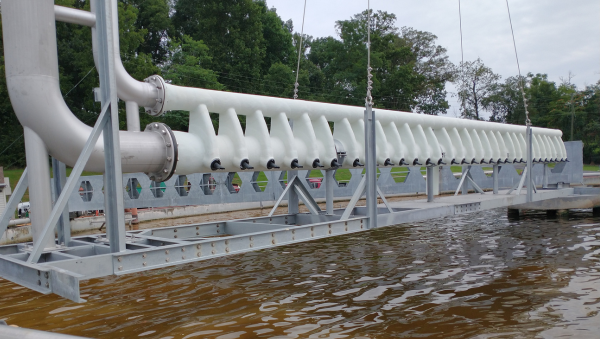
Based on today’s jet and slot injector aeration technology, shallower and wider tanks will likely require a larger aeration system than those that are deeper and narrower. For example, an 18’ deep, 97’ diameter tank will require more injectors, liquid flow, and air flow than a 30’ deep, 75’ diameter tank (Figure 1). Assuming standard oxygen demand of 1,200 lb/hr, the shallower tank will require a slot injector system utilizing 112 injectors with 11,200 gpm of liquid flow and 4,200 scfm of air flow, which in turn will need a combined energy input of 354 bhp. By contrast, the deeper tank will need a slot injector system utilizing 60 injectors with 6,000 gpm of liquid flow, and 2,600 scfm of air flow with a combined energy input of 268 hp. The key factor here is that although there is a reduction in air flow as you go deeper, it is offset by the increase in blower pressure, so there are little energy savings on the air side. However, the near 50% reduction in the number of injectors results in the same reduction in pump flow, so the overall energy savings amounts to 86 bhp. The 30’ deep aeration system would also provide CAPEX savings of greater than 20% compared to the shallow tank aeration system.
Other Benefits Of Deep Tank Aeration
In addition to the improved process efficiency and reduced CAPEX, some reasons for considering a deep tank design include:
Lower operating expenses (OPEX). In the above-mentioned example, the difference in horsepower requirements equates to a saving of 64 kW/hr for the larger aeration tank, which is about 25% less energy. Depending on local electrical service rates, this can save between $60,000 and $100,000 in energy consumption annually, significantly lowering OPEX.
Reduced footprint. If the client has limited real estate in which to build, a basin that is deeper rather than wider can provide the same amount of aeration capacity in a smaller area. In Europe, 8-m to 10-m basins are common for this reason.
Potential for expanded capacity. Depending on the design and customer budgets, deeper tanks can be used in applications where capacity expansion may be needed down the line. This is particularly important when real estate is limited.
Complications To Consider
Large aeration setups aren’t going to be ideal for every application. Some of the factors that may influence tank size and shape include:
Water chemistry. For example, water chemistries that produce a lot of foam may require shallower tanks, as the wider surface area and reduced depth mitigates the severity of foaming. In addition, surfactants, salts, and alcohol-based substances that influence the alpha factor can challenge the aeration tank design.
Geology. In some cases, the water table or other geological factors may make it difficult or expensive to build and install deep tanks. Soil that is too soft may not support the condensed weight of a deep tank over time, causing it to shift or settle.
Community needs. Particularly for municipal projects, local planning committees and community leaders and other social groups will likely have input on the type of construction that can occur in an area. Proximity to estuaries or wildlife habitats may impact how, where, and what can be built, including basin height. These potential factors should be explored as early as possible in the design stage to avoid going back to the literal drawing board.