
Since its inception in the late 19th century, the concept of aerating sewage treatment tanks has undergone evolution. Today, jet aerators play a critical role in municipal, industrial, and agricultural wastewater treatment. However, despite their extensive use and proven effectiveness, jet aerators remain widely misunderstood in the engineering community. This article aims to shed light on the early history, development, and modern-day applications of jet aerators, highlighting their significance in wastewater treatment.
Early History
The roots of jet aeration technology trace back to the work of Dr. Angus Smith, who first explored the idea of blowing air into sewage treatment tanks in 1882(1). This early experimentation laid the foundation for subsequent advancements in sewage treatment processes. In 1914, E. Arden and W. T. Lockett determined that the aeration process was significantly more effective if the “humus solids” were saved rather than discarded(2). This gave birth to the activated sludge process, and for the next 10 years the concept of suspended growth biological wastewater treatment progressed rapidly in both Europe and the United States.
These early activated sludge plants gave birth to the aeration system, utilizing either diffused or mechanical aerators. Some of the early studies in England explored the use of impinging type jets for introducing air into sewage, and in 1927 Martin first used the terms “jet” and “jet system” specific to the aeration process(3). Based on the rapid growth of the process, activated sludge treatment should have become the preeminent biological process virtually overnight. However, patent litigation curtailed most of the technical momentum up through 1935 and allowed the rapid growth of fixed film systems in the marketplace.
It was not until after World War II that the process regained popularity(4). The widespread adoption of activated sludge treatment after World War II revitalized interest in jet aeration technology. In the United States, the application of submerged two-phase venturi jets in industrial activated sludge processes marked a significant milestone in its evolution.
Over the next 20 years, some of the world’s largest chemical and petrochemical companies, as well as a number of other industries, applied ejector aeration technology. Over time, two major application challenges evolved, both of which were associated with the relatively small openings (less than 0.5”) of the primary and outer nozzles. Firstly, the ejectors did not have a high oxygen transfer capacity on a per unit basis. Secondly, the ejectors were prone to clogging due to the occasional presence of trash or larger solids in the process.
These problems were addressed in the early 1970s. New jets had a 1”-diameter inner nozzle and a 2”-diameter outer nozzle, which greatly improved the solids passing capability of the jets. Larger openings also allowed for more liquid and air throughput, resulting in a significant increase in the oxygen transfer capacity of the device on a per-unit basis. Jet aerators could now claim economical, trouble- free operation. Innovations to improve efficiencies and economics increased their value in industrial wastewater treatment plants, including manifold and cluster concepts for feeding multiple jet nozzles in different reactor configurations.
The Energy Crisis And Clean Water Act The energy crisis of the early 1970s and the passage of the Clean Water Act in 1972 underscored the urgent need for energy- efficient aeration technology. Jet aerators emerged as a frontrunner in the quest for more sustainable wastewater treatment solutions. With increased funding for publicly owned treatment works, jet aerators found broader applications in municipal wastewater treatment plants, positioning themselves as key assets in the transition toward environmental stewardship.
However, this same influx of capital from the Construction Grants Program gave birth to a new breed of competitors. By 1980 there were approximately 70 manufacturers claiming to provide high-efficiency aeration equipment. The competition that developed put added pressure on all of the manufacturers, with many struggling for financial survival over the next several years. Even worse, less technically savvy but lower-cost competitors began producing under-designed products. In addition, misapplications undermined the overall reputation of jet aeration technology. For example, a great number of problems arose due to using the technology in plants with poor or no pretreatment or installing jets in aerobic digestors in those same plants. Despite the advancements, jet technology at the time was still ill suited for the large quantities of trash that was often present in domestic sewage in the 1970s and early 1980s. This problem would plague the technology for many years, until the development and rapid application of modern fine screening in the treatment facilities headworks.
The Rise Of Fine Pore Diffusers
The demand for energy-efficient aeration devices led to a resurgence of interest in ceramic fine pore diffusers. Fine pore diffusers release pressurized air through micron sized openings and demonstrate ASCE Clean Water Oxygen Transfer Testing excellent clean water oxygen transfer performance. The establishment of standardized testing protocols further validated the efficacy of fine pore diffusers and set the benchmark for clean water oxygen transfer efficiency.
In 1977, The U.S. Environmental Protection Agency (EPA) sponsored a project at the County Sanitation District of Los Angeles County (LACSD). The project was referred to as “Aeration Equipment Evaluation- Phase 1.” The study evaluated generic types of aeration equipment, including ceramic and membrane fine pore diffusers, jet aerators, and static aerators, as well as various types of coarse bubble diffusers. Phase 1 testing was conducted in clean water, at various liquid depths (10’, 15’, 20’, and 25’), power intensities, and aerator configurations. The test also evaluated eight different data analysis techniques in order to assess the relative accuracy of each one.
The results of the testing were presented in 1980 and showed the two types of fine pore diffusers and jet aerators to be the most “promising” technologies. More significantly, the study established quality baseline clean water performance data for all of the technologies. For the next five years the LA County results became the standard of comparison by which all aeration devices and aeration companies were measured. The testing also confirmed that the clean water oxygen transfer efficiency (the percent of oxygen adsorption or utilization) and aeration efficiency of ceramic fine pore diffusers were superior compared to all other technologies. This finding launched fine pore technology as the preferred aeration technology for municipal wastewater treatment, a market position that the technology still holds today. It also resulted in the shift in focus of some of the jet aeration suppliers to broaden their applications base into a wide variety of industrial applications where the technology was already widely accepted.
Between 1978 and 1983, the EPA and the American Society of Civil Engineers (ASCE) sponsored many conferences and seminars whose sole purpose was to establish a consensus standard for testing oxygen transfer devices. The LA County study was beneficial in streamlining the testing methodologies and data analysis to be considered for a universal test standard. An Oxygen Transfer Test Standard Committee was formed to study the issue and develop a standard protocol for testing. In 1984, the ASCE and the Oxygen Transfer Test Standard Committee jointly published A Standard for the Measurement of Oxygen Transfer in Clean Water. This document became the standard reference for clean water performance testing. Over the years, the standard test has contributed greatly to the understanding of the clean water oxygen transfer capabilities of many competing aeration technologies.
Modern-Day Jet Aeration Systems
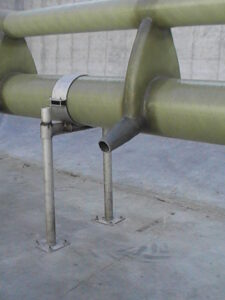
Today’s jet aerators consist of two general configurations of nozzles mounted on specific distribution systems. Both designs are supplied as fabricated, monolithic units. Manifold jet aerators feature jets on either one or both sides of a liquid distribution pipe, while radial jet aerators distribute jets uniformly around the circumference of a central pressurized tank type chamber. As a rule, the jet manifold is used in larger scale applications, and the radial aerators are limited to smaller scale biological processes utilizing circular tanks.
Fiberglass reinforced plastic (FRP) is the most common material for the construction of jet aerators. FRP has proven to be not only an economical material, but it also is durable, lightweight, corrosion resistant, and easily assembled in the field. Typically, the piping for the aerators or air/liquid distribution system is machine filament wound. The selection of the various grades of FRP resins, piping thickness, and design pressure ratings, as well as different abrasion liners, is dictated by the specific application. For material of construction alternatives, several manufacturers now offer the jet aeration system in all stainless steel. In certain applications this material has some advantages and offers a longer design life, although FRP jet aerators with at +20 years already have a much longer design life than any type of diffuser system. Also, an all-stainless-steel offering must be evaluated closely in any industrial application where there is the presence of chlorides or other dissolved salts, making it either not viable or very expensive if higher grades of corrosion-resistant steel are required. Except for a novel jet aerator design employed for thermophilic aerobic digesters and some of the materials of construction improvements associated with the development of this application, most of today’s suppliers of jet aerators offer a very similar design in terms of both materials of construction and performance to what was commercially available in 1985.
Convergence: The Future Of Jet Aeration Technology
In early 2005, the Slot Injector aeration system was introduced to the North American aeration market. Developed in Europe in the late 1970s for a proprietary bioprocess, the Slot Injector is a jet aerator with a slot-shaped propulsion jet and outer mixing jet. The device has smaller openings and is designed to be a higher liquid velocity, higher pressure jet with a unique shape that results in a device that dissolves the same amount of gas (air) as a jet aerator using less than 50% of the liquid flow input. This results in key benefits in terms of the size of the liquid pumping system, greatly reducing the capital cost of the aeration system. Its unique design also offers superior oxygen transfer performance, reduced energy usage, and improved operating flexibility compared to conventional jet aerators. The operational flexibility is born out of the ability to vary airflow and liquid flow to the system, which also optimizes energy savings over a wide range of loading conditions.
Slot Injector technology has taken the jet aeration system to the next level as it maintains all the features of conventional jet aeration with the added benefits noted above. It is ideal for industrial treatment plants where fine screening is employed and plays an important role in water reuse, as it is well suited and has been employed regularly as the aeration system of choice in a large number of MBR processes. As engineers navigate the complexities of wastewater treatment in the 21st century, KLa Systems has developed the process and skills to converge decades of experience, knowledge, and data into the ultimate device. Our team brings together 35 years of experience producing a combined 1,400 projects in more than 30 countries. Through continuous innovation and collaboration, we strive to marry various elements — materials, manufacturing techniques, design principles — to custom design the most effective and efficient solutions for wastewater treatment. While the journey may be challenging, the promise of superior performance and environmental impact makes it a pursuit worth undertaking.
1 Alleman, J.E. and Prakasam, T.B.S., “Reflections on Seven Decades of AS History,” Presented at the 55th Annual Conference of the WPCF, 7 October 1983.
2 Alleman, J.E. and Prakasam, T.B.S., “Reflections on Seven Decades of AS History,” Presented at the 55th Annual Conference of the WPCF, 7 October 1983.
3 Martin, A.J. The Activated Sludge Process, MacDonald and Evans, London, 1927
4 Alleman, J.E. “The Genesis and Evolution of Activated Sludge Technology,” School of Civil Engineering, Purdue University, West Lafayette, IN, 1996.