









523
Company
11746
fa-lightbulb-on
About KLa
Discover our history in jet aeration, proven field performance across 38+ countries, and integrated approach to complex wastewater challenges.
11747
fa-droplet
IWS Companies
Explore our specialized family of brands delivering industry-leading aeration, filtration, and modular wastewater treatment technologies.
11750
fa-unicorn
Integrated Water Services
Founded in 2003, IWS is our parent company and turn-key provider of water and wastewater solutions across North America.
11748
fa-unicorn
Complete Filtration Resources
An industry leader in process filtration and industrial wastewater solutions, with deep expertise in the food and beverage industry—specifically in the dairy sector.
11749
fa-unicorn
Hi-Line Industries
Delivers high quality metal fabrications, special purpose equipment, custom machinery, and manufacturing services.
11751
fa-unicorn
M|MBR Systems
Industry-leading provider of replacement parts, retrofits, and modular systems to membrane bioreactor (MBR) customers.
11752
fa-unicorn
Tetrasolv
Tetrasolv Filtration, an industry leader in specialized filtration, separation, and mobile media services and rentals.
11753
fa-unicorn
AESINC
AESINC designs, engineers, and assembles reverse osmosis systems for seawater desalination, brackish water treatment, and high-purity water applications.
Founded in 2003, IWS is our parent company and turn-key provider of water and wastewater solutions across North America.
An industry leader in process filtration and industrial wastewater solutions, with deep expertise in the food and beverage industry—specifically in the dairy sector.
Delivers high quality metal fabrications, special purpose equipment, custom machinery, and manufacturing services.
Industry-leading provider of replacement parts, retrofits, and modular systems to membrane bioreactor (MBR) customers.
Tetrasolv Filtration, an industry leader in specialized filtration, separation, and mobile media services and rentals.
AESINC designs, engineers, and assembles reverse osmosis systems for seawater desalination, brackish water treatment, and high-purity water applications.
aside column

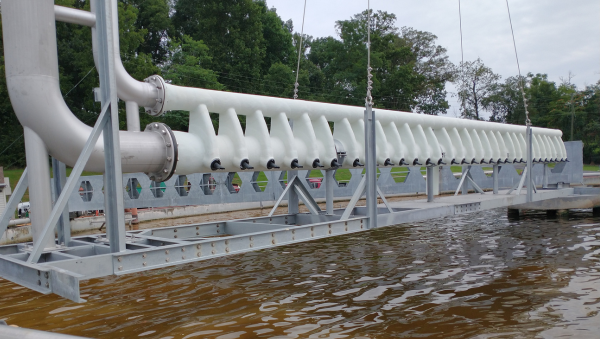
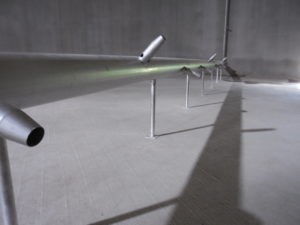
Jet Mixers are widely used in both municipal and industrial wastewater treatment facilities to blend the plant influent and suspend light organic solids in circular equalization tanks. Other applications for these powerful hydraulic mixers include mixing anoxic tanks and anaerobic reactors with the latter application being for industrial waste streams only. Jet mixers are the technology of choice based on their flexibility of operation and configuration in small and large diameter tanks, the highly corrosion and abrasion resistant in-basin components, the use of simple external pumping systems, and a +20-year design life.

When designing jet mixing systems there are four key design criteria that need to be considered and a properly designed jet mixing system will consider all the above criteria balancing which ones are most important for the best results:

  • Mixing Intensity: Also referred to as power density this parameter measured in Bhp/MG (W/m3) is a useful tool in sizing Eq. Tanks, Anoxic Tanks and Anaerobic Reactors. Mixing intensity ranges are based on specific wastewater characteristic (TSS concentration for example), tank volume, and hydraulic retention time.
  • Distribution of Mixing Energy: One of the true advantages of jet mixing technology is the ability to distribute the mixing energy from one pump to as many as 100 different locations across the area of the tank. This is a key feature for suspending light solids and maximizing liquid blending.
  • Turnover Time: Is calculated by dividing the total circulation rate generated by the jet mixer into the tank volume at maximum liquid depth. As a rule of thumb a bulk fluid volume is considered completely mixed if there are 3-5 turnovers per HRT.
  • Bulk Fluid Velocity: The thrust imparted on the bulk fluid as the liquid exits the jet creates a small head gain while producing a mostly horizontal velocity. Projecting the fluid velocity is a key design consideration for light solids suspension.